AfriForum report reveals brutality of farm attacks
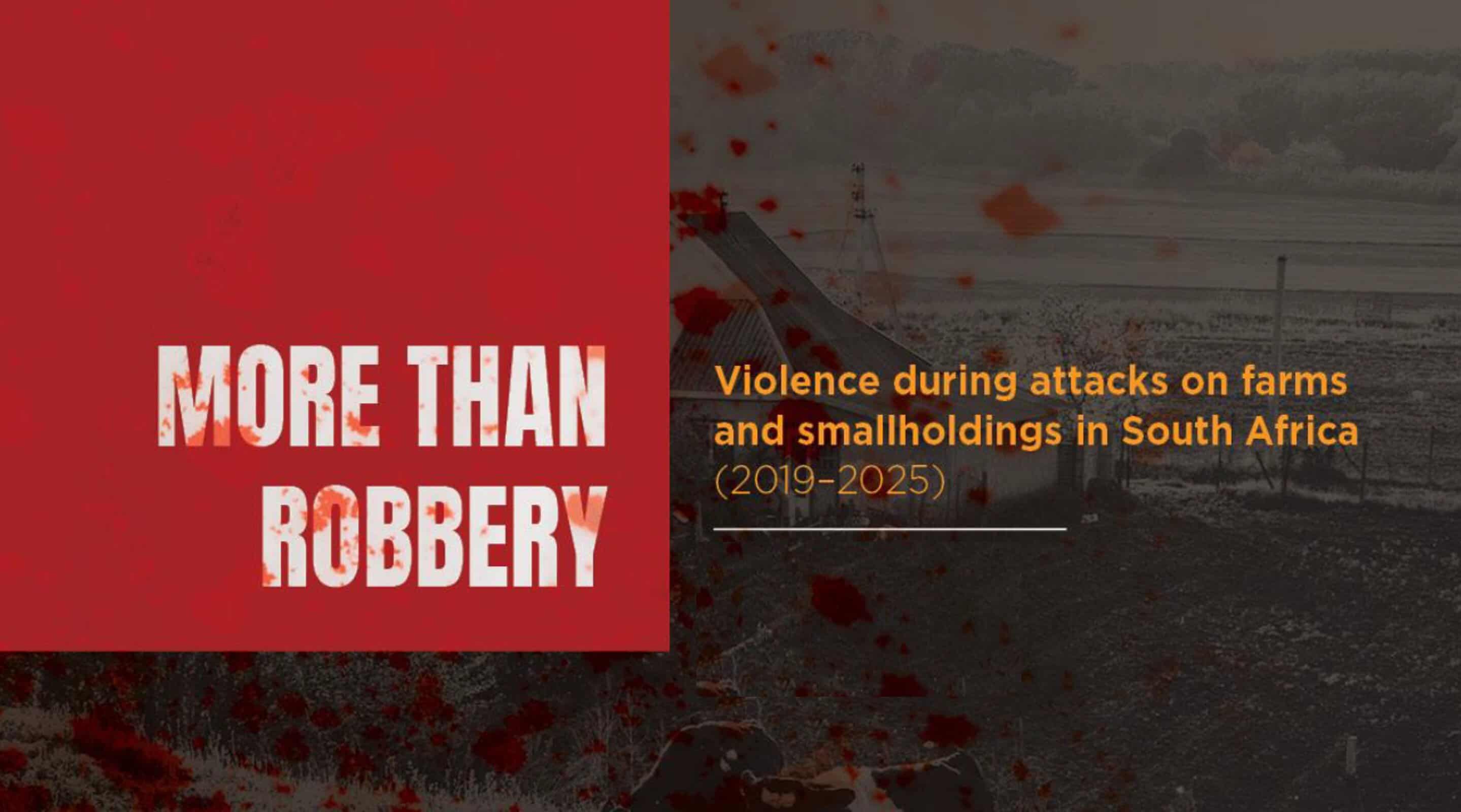
A new AfriForum report – which examines 47 separate violent farm attacks that took place over a seven-year period – reveals a recurring pattern of torture in which attackers use various identified methods to physically and emotionally abuse victims. This report, titled More than robbery: Violence during attacks on farms and smallholdings in South Africa, 2019–2025, was released today and confirms that the excessive violence characterising some farm attacks demonstrates that these incidents are not merely robberies.
Based on this study, the civil rights organisation concludes that the violence employed during the analysed farm attacks is of such a nature that it can indeed be classified as torture; that torture during farm attacks is a phenomenon occurring across the country; and that a case could be made to argue that farm attacks are indeed extraordinary crimes.
AfriForum’s research reveals that the victims of the studied attacks endured repeated torture, burning, stabbing, strangulation, and severe physical, emotional, and sexual abuse. The study presents four key findings, highlighting that farm attacks involving torture share common characteristics regarding the weapons used, the physical injuries sustained by victims, the use of extortion, and the use of excessive violence.
According to Jacques Broodryk, AfriForum’s Chief Spokesperson for Community Safety, the extremely violent attacks studied are not confined to any single part of the country. “These brutal attacks occur in every province and confirm that farm attacks constitute a national rural safety crisis requiring a targeted and specialised response,” Broodryk explains.
AfriForum therefore once again calls on the government to recognise farm attacks as a priority crime and to combat them – like other priority crimes (such as cash-in-transit robberies, gender-based violence, illegal mining, and wildlife trafficking) – through a specialised approach and strategies.
“If the government can acknowledge the unique nature of cash-in-transit robberies and wildlife trafficking and develop specialised strategies to combat those threats, there is no logical reason why farm attacks should be handled differently,” emphasises Broodryk. “The nature of farm attacks requires specialised intelligence, targeted investigations, appropriate policing resources, and effective cooperation with rural communities.”
AfriForum also calls on the government and political leaders to unequivocally condemn inflammatory and hateful rhetoric directed at South Africa’s farming communities – such as the “Kill the Boer” chant.
“Political leaders cannot claim to be serious about combating violence while remaining silent when inflammatory rhetoric targeting a specific community is normalised,” says Broodryk.
AfriForum’s latest report further confirms that rural communities cannot afford to rely solely on the state’s response to violent crime. “While the constitutional responsibility for public safety rests with the government, communities must be empowered to play an active role in protecting themselves, especially where police resources and response capacity are inadequate,” emphasises Broodryk.
AfriForum will, therefore, continue to expand and strengthen its 178 neighbourhood and farm watches and invest in volunteer training as well as the expansion of its specialised response capabilities, technology, and communication networks. Because the physical and emotional consequences of farm attacks extend beyond the immediate crime scene, the organisation will also expand the capacity of its trauma unit and continue documenting farm attacks. AfriForum will also continue to expose the realities rural communities face and apply pressure on the government to ensure the effective implementation of the national rural safety strategy.